Special-purpose machinery
Assembly, testing and production automation
TB Müller develops special-purpose machines for processes with no standard equipment: assembly automats, test and measurement stations, feeding and advancing systems. We supply mechanics, electronics and controls from one source — we plan and program the control systems ourselves. Because we come from part and tool design, we usually know the component the machine must handle down to its tolerance.
- Machine types
- Assembly automats · Test stations · Feeding systems · Vending systems
- Scope
- Mechanics · Pneumatics · Electronics · Controls · Safety
- Sectors
- Automotive · Electrical · Electronics · Household goods · Start-ups
- Control technology
- Planned and programmed in-house
- Distinctive
- Machine and part are laid out together
What we build
Special-purpose machines arise where a process does not fit a catalogue machine. Our machine building covers these four groups.
Assembly automats
Automated joining processes for assemblies that must come together reliably in series. The precondition is a tolerance chain that permits automation at all — which is why we calculate it beforehand.
- Joining, pressing, screwing
- Transfer and handling axes
- Feeding and separation
- OK/NOK part rejection
Test and measurement stations
Stations that check function and dimensional accuracy within the cycle — not as a spot check in the measuring room, but on every part in the line.
- Functional testing
- Dimensional and force measurement
- Camera-based inspection
- Documentation of test results
Feeding and advancing systems
The inconspicuous discipline where lines most often fail: bringing parts to the processing point correctly oriented, without jams and in cycle.
- Feed grippers
- Separation and orientation
- Magazines and hoppers
- Cycle coordination with processing
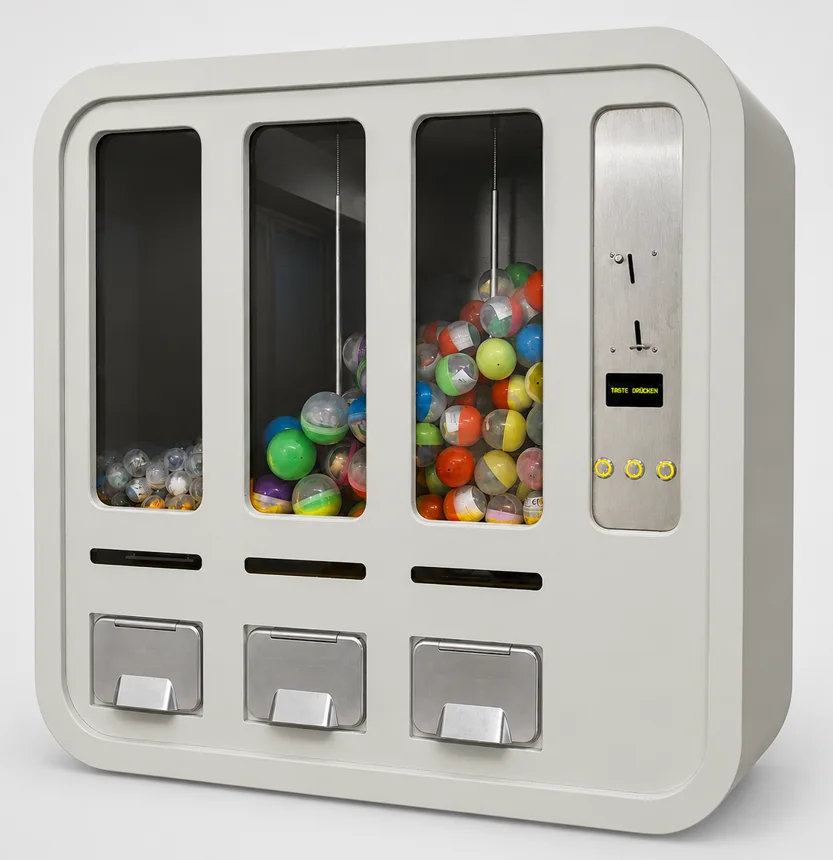
Customer-facing automats
Machines not operated by trained staff. Here operating logic counts alongside the technology — and how easily the operator refills and services them.
- Electronically controlled vending machines
- Keypad product selection
- Card payment instead of coin operation
- Illuminated product presentation
What we take on
Mechanics and design
Frames, axes, grippers and fixtures — designed for stiffness, accessibility, and whether an operator can reach the right point within two minutes in case of a fault.
Controls: planning and programming
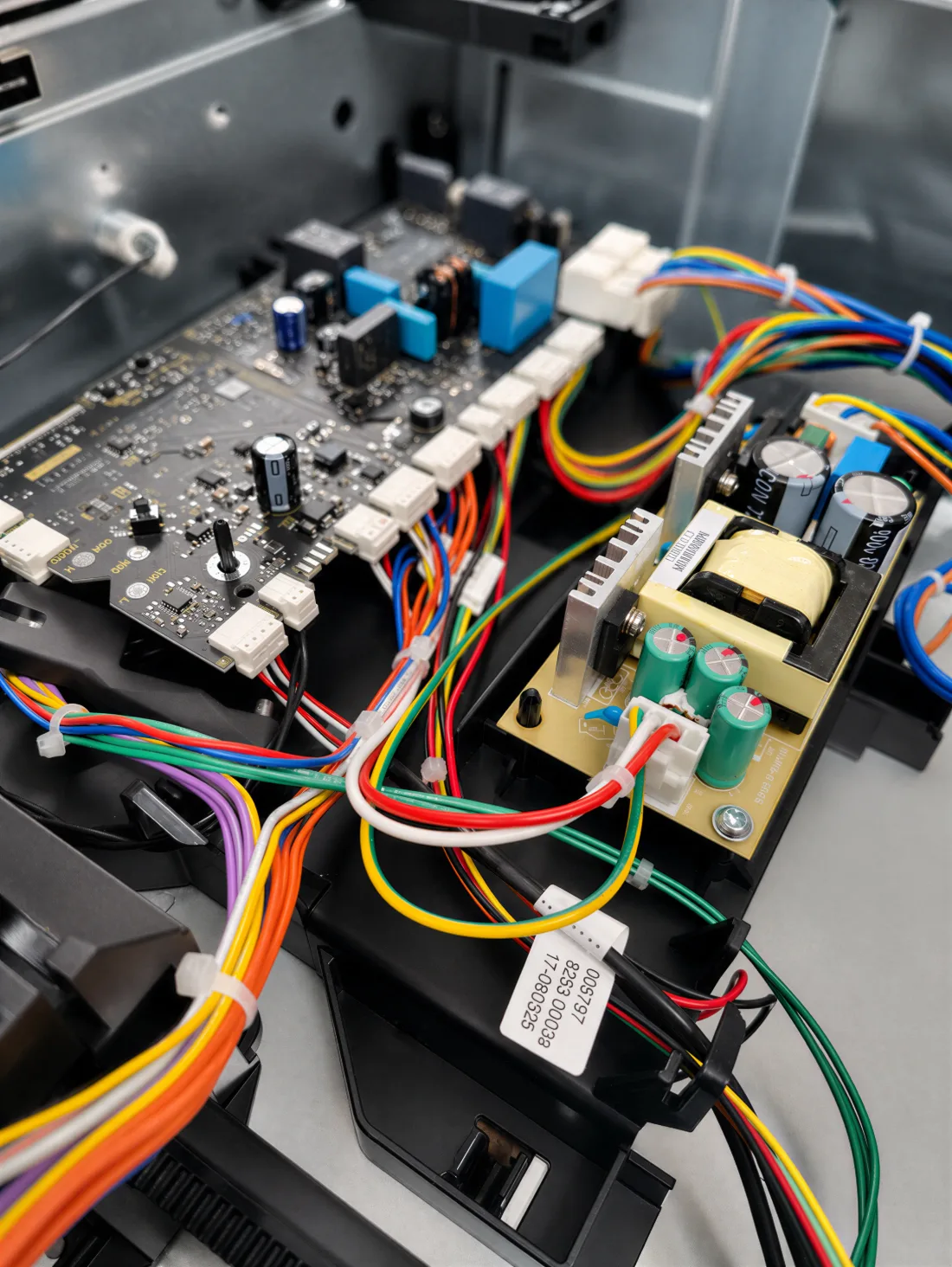
We plan the control cabinet and write the control software ourselves. This shortens commissioning considerably, because mechanics and software do not have to meet for the first time at the machine.
Electronics integration
Boards, sensors, drives and pumps are integrated into the design: heat dissipation, sealing concept and mechanical and electromagnetic protection are part of the layout.
Cycle time and availability
Cycle time, availability and changeover effort are targets we design against — recorded in writing before design work starts so they remain verifiable at the end.
Safety and CE
Guarding, safety circuit and documentation are part of the delivery. Safety is designed with the machine, not fenced in afterwards.
Prototype and commissioning
We build critical stations as functional prototypes beforehand. What does not run to cycle on the prototype will not run better in the line — and learning that before series build-up is cheaper.
Example structure of a line
A special-purpose machine is a chain of stations above a shared control layer. The cycle of the slowest station determines the output of the entire line — which is why it is laid out first.
Typical sequence of a special-machinery project
-
Capture the process
Observe the existing process on site, measure cycle times and record the actual causes of stoppages.
-
Concept and assessment
Assess several line concepts against space, degree of automation and investment budget.
-
Functional prototype
Build the critical station in advance and test mechanics and electronics in combination.
-
Design
Detail the mechanics, control cabinet and control software — for manufacture and assembly.
-
Build and commissioning
Build the line, commission the controls, demonstrate cycle time and availability against the targets.
-
Handover
Training, documentation and CE files, plus support for changes during operation.
Frequently asked questions
From what volume is a special machine worthwhile?
Volume alone is not decisive; it is the combination of cycle time, labour cost per part and inspection effort. We work this through with you before design — including the honest answer if a semi-automatic solution or a fixture is cheaper.
Do you program the controls yourselves?
Yes. Control planning and programming are done in-house. This is a key reason why commissioning our lines is short: mechanics and software are created in parallel and with the same people.
Can you convert or extend an existing line?
Yes. Often it is about replacing a station, adding an inspection or converting a line to a new product variant. We take the existing safety circuit and control system as given constraints.
Do you also handle CE conformity?
Guarding, safety circuit and technical documentation are part of the delivery. The specific scope of CE responsibility is defined per project, as it depends on who places the line on the market.
What sets you apart from a pure machine builder?
We come from part and tool design. If an assembly line has tolerance problems we can change the part instead of only the machine — that access to both sides shortens root-cause analysis considerably.