Sappl handle
Tool handle for forestry and garden tools
- Client
- Forestry & garden tools
- Sector
- Tools
- Scope
- 2K moulding · Gas injection · Tooling
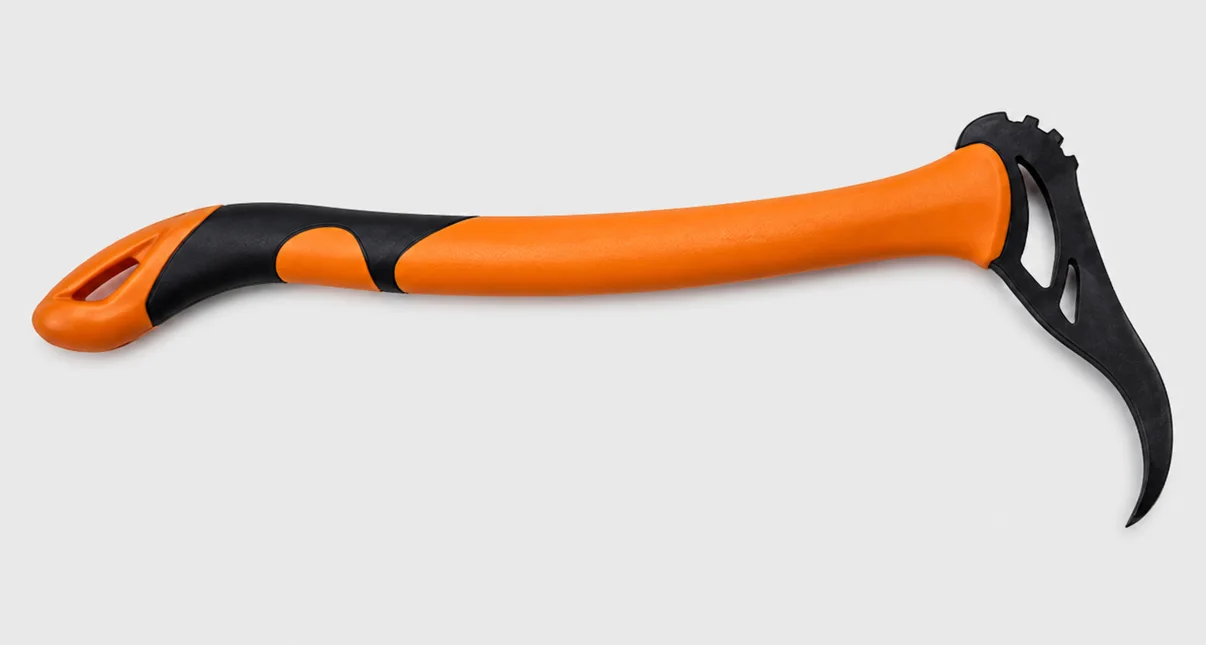
For a client in forestry and garden tools we developed the handle for a Sappl — a tool used to pick up, lift and move wooden logs. The task was to design a handle that securely holds a functional metal hook, performs ergonomically in practice and can be produced economically in series.
From sketch to concept
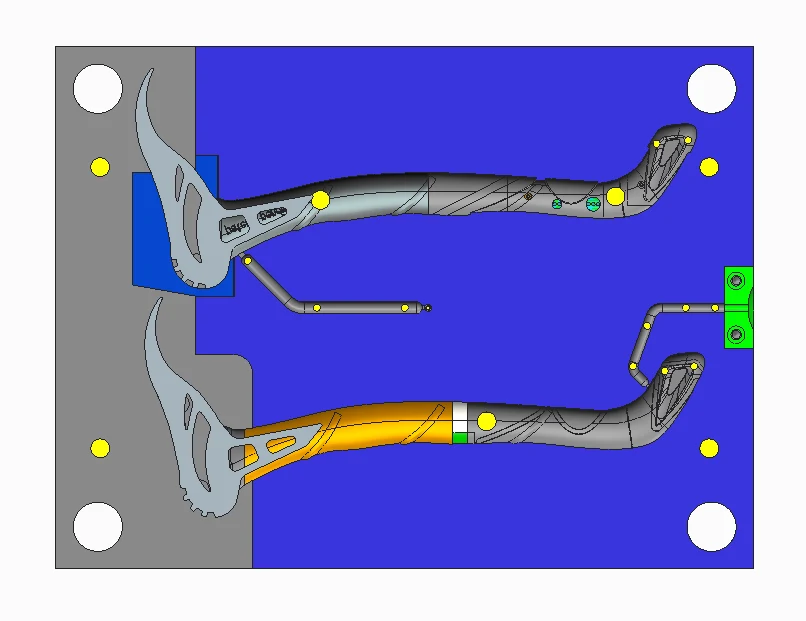
From the concept phase it was clear that two requirements had to be solved at once: a secure, mechanically robust connection between the metal hook and the plastic handle, and a weight and grip characteristic that benefits the tool in practice. We opted for a two-stage production concept: the rigid component of glass-fibre reinforced polypropylene (PP-GF) is moulded in the upper cavity through a centrally arranged machine nozzle. The metal hook is overmoulded directly by the rigid component; deliberately placed windows in the geometry create a positive mechanical bond between the two materials.
To save material and weight without compromising stability, we specified gas injection technology for the shaft: after the melt is injected, gas is introduced through a separate nozzle, forming the shaft hollow at its core. This design trick not only saves material but also keeps the Sappl head-heavy — an effect that noticeably improves handling.
Engineering with series production in mind
For production on a two-component machine the process was laid out consistently for economy and process reliability. The KTL-coated metal part is inserted by hand and held securely in position by a magnet before being overmoulded by the rigid component. In a second step the soft component is applied by the injection unit offset at 90 degrees — it forms the black grip areas and improves handling and feel. Alongside this we ran a filling study for the rigid component to evaluate flow paths, weld lines and holding-pressure behaviour ahead of tool design.
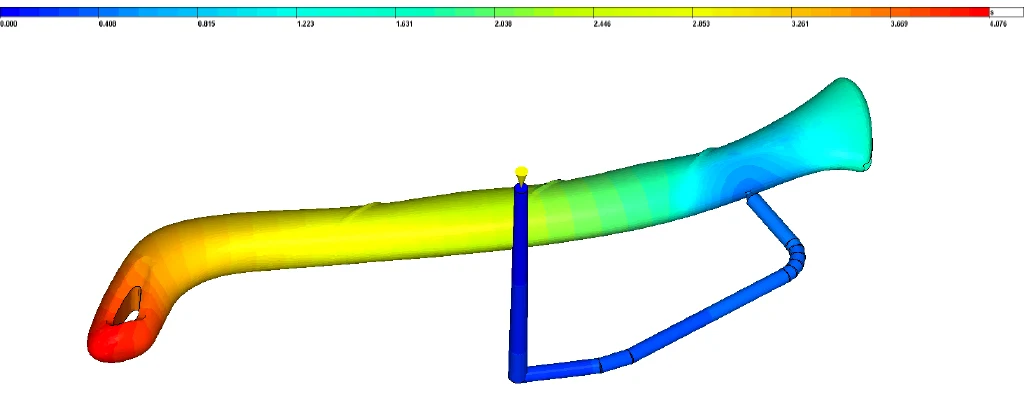
From the first design idea came a production-ready Sappl handle that unites function, ergonomics and economy in one part: the KTL-coated metal hook is securely bonded into the rigid component, the gas-injected shaft saves weight while keeping a head-heavy, practical balance, and the soft grip zone ensures a secure hold in demanding use.
Three processes interlock in a single part: 2K moulding, gas injection and insert overmoulding. Each imposes its own demands on wall thicknesses and flow paths — and they had to be reconciled together.