
Bottle closure with flip-top function
Packaging solution
- Client
- Packaging industry
- Sector
- Packaging
- Scope
- Engineering · 64-cavity mould
For clients in the packaging industry we have developed closures many times. One example is a round closure with an integrated flip-top function. The starting point was a customer-supplied sketch with the closure's core dimensions plus the geometry of the matching bottle for a soap product. We had designed living-hinge closures several times before, so the empirical values for wall thicknesses and material behaviour were already available.
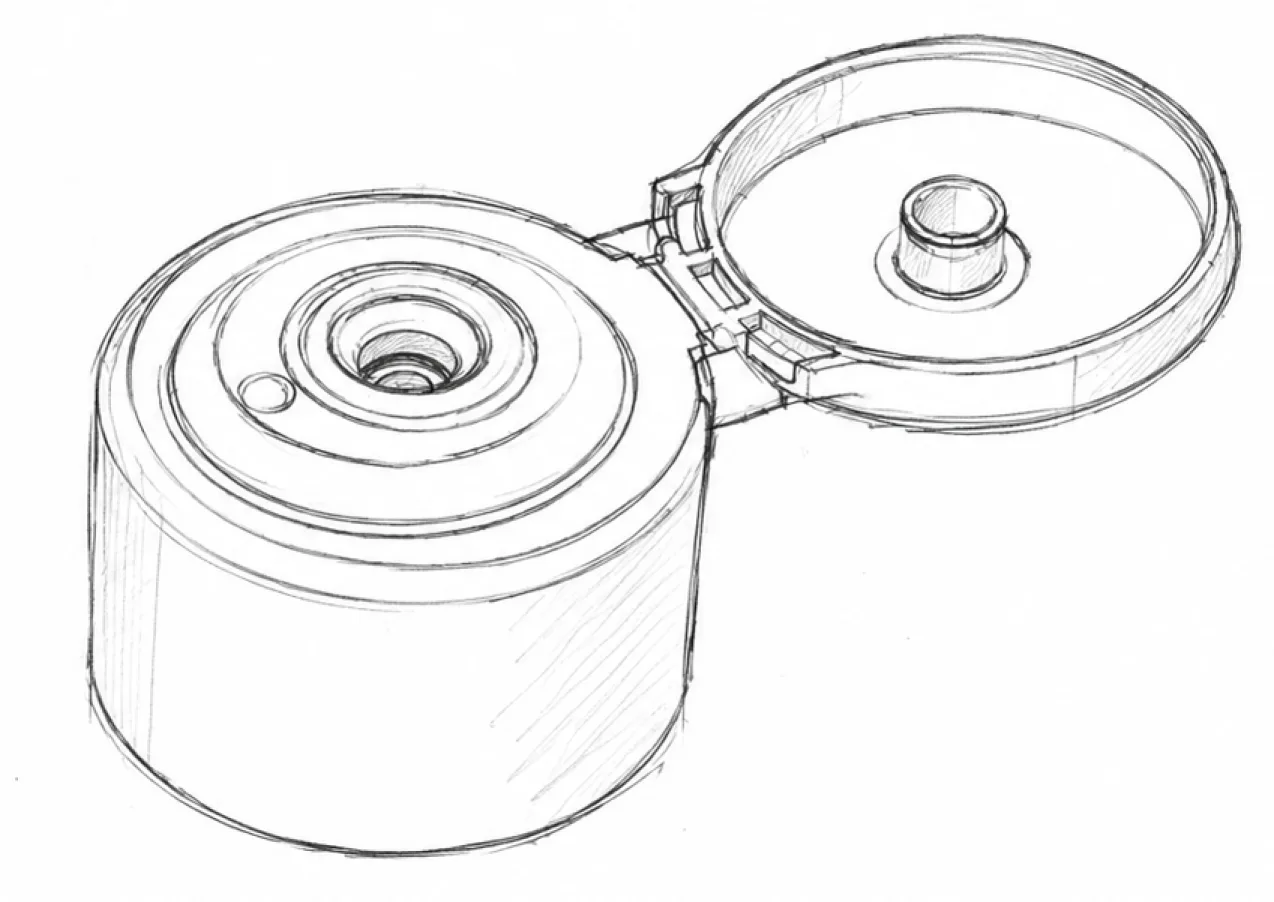
From sketch to concept
Based on the sketch and the bottle dimensions we designed a matching closure that integrates a flip-top mechanism on top of the basic function. At its core is a living hinge laid out so that, once past the tension point, the lid swings on its own into the open or closed position and stays there stably. This over-centre kinematic requires precise coordination of geometry, wall thicknesses and material behaviour — empirical knowledge drawn directly from our previous living-hinge projects.
Engineering with series production in mind
Tooling requirements and design for manufacture were considered from the early development phase onward. For this project we additionally designed a 64-cavity injection mould, which the client then built. It allows the closures to be produced economically in series with a short cycle and a high cavity count. Because closure and tool came from one source, cavity count and cycle time could be laid out directly against the part geometry.
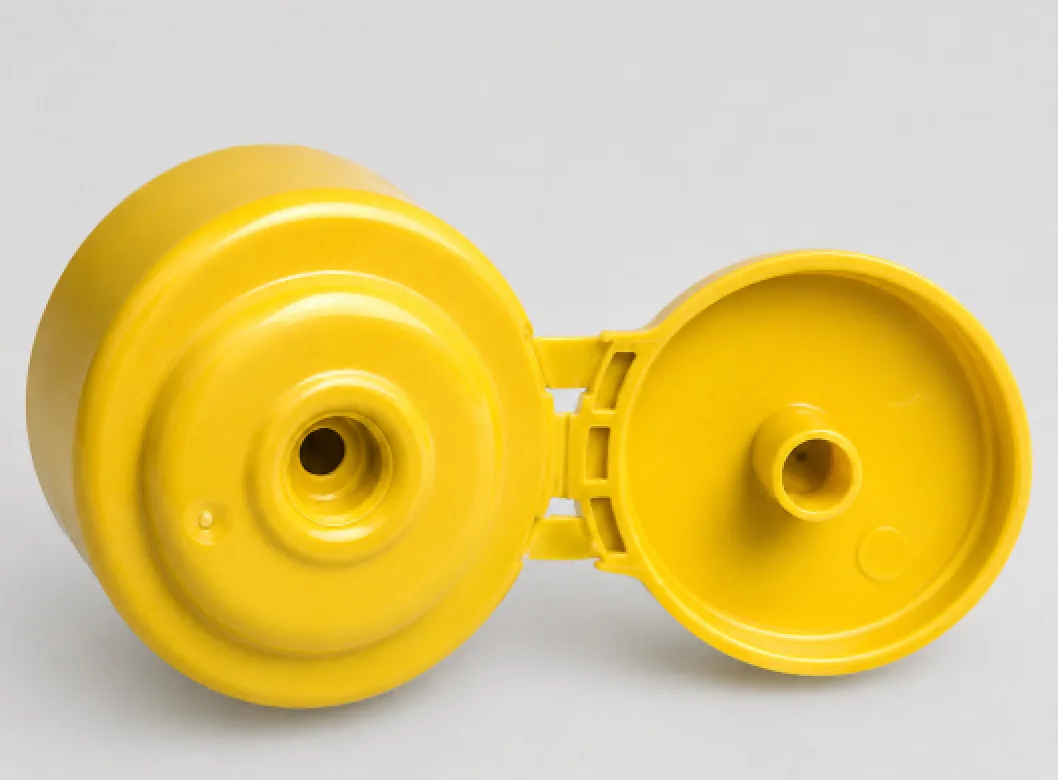
Thanks to our many years of experience in developing closure systems, the new closure was successfully developed within a very short time. Particularly for the layout of the living hinge and the straps for the flip-top movement, we could draw on extensive know-how and proven empirical values from numerous previous closure developments.